

EXPLAIN "THE BEGINNINGS" BY ANTONIO MORESCO TO ME RIGHT NOW
DON'T DUMB IT DOWN INTO SOME VAGUE SHIT! EXPLAIN MORESCO TO ME RIGHT NOW! WHAT THE FUCK IS "SHUCKED"? WHY DOES HE SAY "VISAGE"? DON'T DUMB IT DOWN

DON’T EXPLAIN, ONLY DESCRIBE.
— WITTGENSTEIN

Crystals and pixels
“We’re a bit disconcerted by this novel!” the man added all of a sudden.1
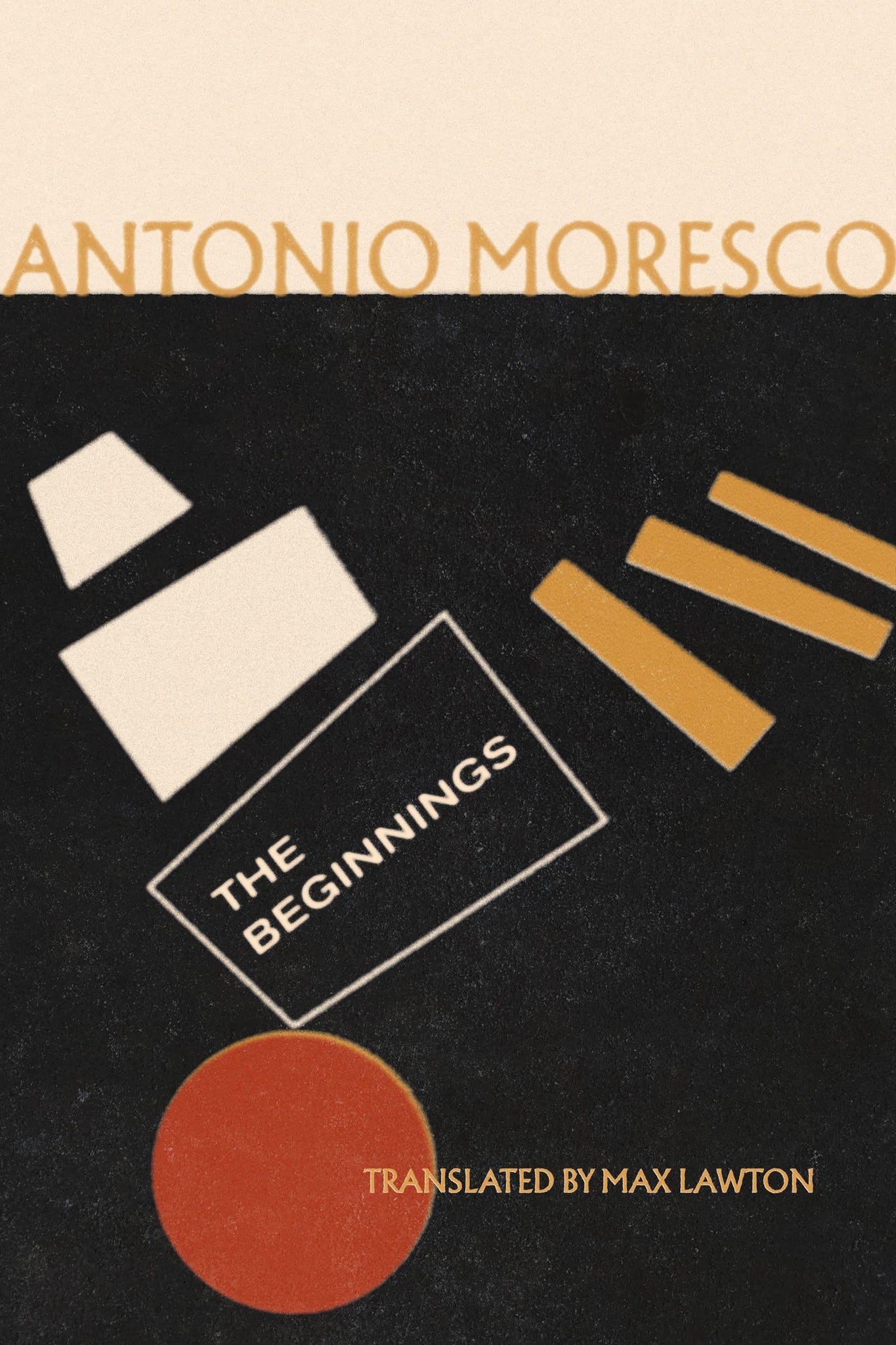
The Beginnings by Antonio Moresco—the first book in his Games of Eternity trilogy, newly translated by Max Lawton for Deep Vellum—opens in a seminary. The reader traverses now smoothly and now in staccato fashion the visual-proprioceptive world of the observing narrator, who, maybe importantly, has also stopped speaking.
That seems like almost all—for a while. The plot of The Beginnings is divided into three parts, like three separate threads dipped over and over into the solution of Moresco’s prose around which increasingly strange crystallizations form.
The narrator moves through three worlds in parts 1, 2 and 3, respectively: that of a seminary student; that of years-of-lead Italy, with its chaotic street clashes and riots; and that of a comically paranoid (and weirdly recursive) literary/publishing world. He seems to graduate from each one into the other, remaining—as one faithful to the words of Rilke or Meister Eckhart—a beginner. These vertically hanging plot threads provide the elementary structure of the novel, but what I’m interested in—and what made me read almost 700 pages of vertiginous, crazy prose—are the crystallizations creeping over these threads.
The image of crystallization is an appropriate one. I think of the scene in Thomas Mann’s Doctor Faustus, where the borders of the organic and inorganic are made wonderfully but also disturbingly ambiguous before the eyes of the young narrator.
The crystallization vessel in which this [experiment by Adrian Leverkühn’s father] transpired was filled to three-quarters with a slightly mucilaginous liquid, diluted sodium silicate to be precise, and from the sandy bottom up rose a grotesque miniature landscape of different colored growths—a muddle of vegetation, sprouting blue, green, and brown and reminiscent of algae, fungi, rooted polyps, of mosses, too, but also of mussels, fleshy flower spikes, tiny trees or twigs, and here and there even of human limbs—the most remarkable thing my eyes had ever beheld, remarkable not so much because of their very odd and perplexing appearance, however, but because of their deeply melancholy nature. And when Father Leverkühn would ask us what we thought they were, and we hesitantly answered that they might be plants, he would reply, “No, that they’re not, they only pretend to be. But don’t think less of them for it! The fact that they give their best to pretense deserves all due respect.”2
The pace of the descriptions (forming around the plot threads) create a mounting effect of suspicion—not a “mounting suspicion”; a mounting effect of suspicion—as though creeping around behind the reader, behind every phenomenological world-description, behind every oddly chosen word, maybe behind the “narrator”—it seems like you begin to suspect that there is something else going on with the book other than those very sentences you are reading.
If this seems weird, we’re on the same page.
The narrator watches the father superior in the seminary. He watches the lights in the city, further off. He watches the other seminary students climb a lamppost. He describes in language that is sometimes beautiful, sometimes repulsive, sometimes funny, his recent circumcision, the black nun who he catches a glimpse of, a certain paper he has been writing on, the strange motions and speech of the priests. The entire time, Moresco courts a relentless sense of jamais vu whereby the familiar reveals itself as uncanny.
The bouncy, evasive little electron of an effect of a suspicion quickly trades valence with its opposite at any given space in the novel—because The Beginnings is an extremely spatial book, a kind of hyper-Euclidean exercise that makes fun of any over-serious appreciation for readerly temporality… —anyway, this electron flips from 1 to 0 and makes you say: No, there isn’t anything else going on with this book… is there? Oh, now I think there is something else going on. Except, wait…
You remain suspended or shunted—or “shucked,” of which more in a moment—between these two possibilities. What is going on in this book? Fascination mounts, as in a detective story, except every mote of light, every inscrutable piece of dialogue, is under our semblance of a suspicion. For what crime? Committed by whom? We cannot say and so read on.
It’s crucial to note that Moresco identifies characters in a simple, descriptive mode: none of them have real names—although what is a “real name”? (This is the kind of question or pseudo-question the book forces you to constantly ask yourself in metaphysico-linguistically paranoid fashion…) But it’s significant: a suspension of naming is part of Moresco’s strange apparatus of description.
Naming is somehow hostile to the integrity of his method. A name would shatter the crystal forming before us on the thread of the “plot.” Naming sets up a layer of language that cannot be further explicated—further shucked.3
“To shuck” is Max Lawton’s translation of one of Moresco’s favorite words, “Sgranare.” Francesco Pacifico, in his introduction, explains that this word is both “a blast and a translation nightmare.”
One-hundred-and-fifty-plus pages into the book, Moresco discovers a word he likes. A verb. “Sgranare.” “Sgranare” means two things, plus a third one I couldn’t see represented in the Cambridge Dictionary. “To shell/husk/shuck,” as in “to shuck an ear of corn,” as in “to shuck peas.” That’s one. The other is “sgranare gli occhi.” “To open one’s eyes wide.” The third one I’m talking about evokes a sense of separation between atomic parts. You could metaphorically handle it by using “pixelated”; you could say spaced out. Grano = grain. “Sgranato,” the past perfect, might sometimes mean “grainy,” but more often it means “having just become grainier.”4
The lack of proper naming takes Saint Augustine’s prime assumption about language, that its fundament is the name, and obliterates = pixelates = shucks it right out of existence, Wittgenstein-style. Augustine:
When they (my elders) named some object, and accordingly moved towards something, I saw this and I grasped that the thing was called by the sound they uttered when they meant to point it out. […] Thus, as I heard words repeatedly used in their proper places in various sentences, I gradually learnt to understand what objects they signified[.]5
The nameless world of Moresco’s The Beginnings is like a mounting Schoenberg string sextet for eyes-wide-open, a speeding camouflage pattern of the obliterative variety. You look deeper into the surface of the chaos and wonder again: What is going on in this book?
(Even the title obeys this pseudo-nominative rule. Here, a character is “the Fop,” there she is “the woman” —and what are we reading? Oh, you know, “the beginnings”. . . )
But if Moresco’s language is a kind of camouflage, I do not believe it is meant to conceal anything at all. It is a camouflage that has miraculously come into aesthetic self-consciousness, joyful and bewildering for its own sake.
I imagine something like the “pixelated,” granular Luxembourgian M2011, if it were moving:
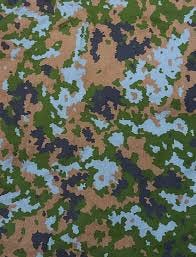
The prose of The Beginnings is a camouflage that wants nothing more intensely than to fully reveal itself in all of its disruptive possibilities.
Against explanation
Our crystalline narrator-observer is like a denominator in an infinitely complex fraction severed from any possibility of a fixed numerator. He is a little x separated from the All by a very, very thin fraction line. This line becomes the lens-medium of his entire field of vision that includes the world in violently fluctuating and indeterminate numerator-magnitudes. . . The numerator of the world passes through this crystalline lens— —— ———hypnotically.
(The Beginnings is fun to read.)
In the beginning (whatever that means), we see that a man wearing glasses has appeared at the gates of the seminary—they eventually let him in, or let him back in, for it seems that maybe he has been there before.
Then the man with the glasses disappeared for a while. The air had become more limpid, warmer, there came a scent that seemed to have come from nowhere. Some time had passed, I had seen the hand with the lighter nails twice more inside the refectory carousel. The summer observance of napping after lunch had begun. I would stay awake for a long time in the dormitory, immobile and penumbral, among the aluminum reflections of the bedside tables and headboards of the beds lined up in a double row, under the single sheet of scented plaster. A few beds further on, the Cat [one of the priests] was sleeping or seemed to be sleeping, silent and still, with his knees raised up asymmetrically beneath the sheet, which stretched out to points quite distant from one another and most unexpected, as if under it were not a man, but a spinning wheel or some other bit of complex machinery. In the opposite row, a tad askance, the head of the deaf-mute seminarian took its repose, lightly beaded with sweat. I would rise up from my pillow to see if his crust [referring to the deaf-mute seminarian’s gelled hair]—the little lights inside it had recently started to turn on much later in the day, as the sky remained bright until it was time to go back to the dormitory for the night—were not melting in the great heat.6
Over and over, the slowly forming prose makes us wonder if maybe we are reading a kind of hyper-Knausgaard… but at every such attempt, a phrase of Wittgenstein’s sounds through my head:
Don’t explain, only describe.
This is Moresco’s method, but it also wells up out of us, his pleasantly surprised readers. Repeatedly, always repeatedly, you will want to explain and be explained to, but all you will get are descriptions, actions, observations, actions, descriptions and descriptions—no explanations. Explanations defuse; Moresco explodes, or crackles, or “crepitates.” If there is a simile or a metaphor, the plane of comparison is as real as that of the compared. Eventually, we learn to relax, let go of our explanatory obsession and—at last—explore.
The time for Chekhov’s gun has passed—this is Moresco’s gun cabinet, which also might be on fire.
Now, the flames had joined together into a single front that rose up into a cusp. They seemed to wish to unravel themselves from the bed of the heap so that it might fly away, torn free like a great crust. They unraveled, deboned through space, the wall having trouble containing them, shooting out from very low areas in little tongues, shucking into the cracks between the bricks, gnawing at even deeper points of the cusp, exposing at its peak skeletons of absolutely unknown objects, hurling them very far away, incinerating them for an instant before one was able to recognize them.7
Books like The Beginnings confirm a suspicion I have held for a while now: that the philosophical approach of phenomenology expresses itself best (justifies its existence) via the novel. But this “phenomenology” thing is already to SUBSTRACT something from Moresco. SIC; substract captures what I mean perfectly; to call Moresco’s prose “phenomenological” first abstracts and then removes, subtracts, something from it in a way that misses the point by over-saying it. (It’s an attempt at an explanation, not a moment of description.)
The phenomenologist sheds her clothes and dances a witches’ sabbath of discovery in such a novel.

Don’t explain, only describe: As readers who are either trained or addicted, or both, to constant explanation, and so the desire for the same, woven into everything, this is actually a very, very difficult demand, as difficult as it is worthwhile. It is what Wittgenstein elsewhere called “going the bloody hard way.” Moresco does it, or convinces us that he has done it, so that we don’t have to—we get to explore the chaos of what is never explainable but begs to be described—ostensibly, a kind of uncreated creation.
It would probably be far too “explanatory” to think of the original title of The Beginnings—Gli esordi—also as something like The Initiations.
Sempio and the magician
In the beginning was the act.
— Goethe’s Faust
Regarding the proliferating action of The Beginnings—indivisibly entangled with the spindly, viscous serifs of its prose—we might say, taking the words right out of Walter Kaufmann’s mouth as he recounts Goethe’s own method-of-no-method in Faust:
Goethe laughed at those who “come and ask me what idea I sought to embody in my Faust. As if I myself knew that and could express it! ‘From heaven through the world to hell,’ one might say in a pinch; but that is no idea but the course of the action.”8
There is something similar going on in Moresco, but instead of “from heaven through the world to hell,” it’s from silence through the infernal purgatory of the world to an affirmative articulation of that very same world. (I can only imagine, for now, how or whether Songs of Chaos, book 2, will advance this affirmative bent.)
The three vertical threads of plot are all crystallizing their own YES, their own affirmation of being, life, language, action, etc.
The language becomes explicitly part of the action by virtue of the narrator’s silence in Part 1. When he begins speaking in Part 2,9 something shifts and the action accelerates: ostensible car chases, speeches, gory street clashes between rival political groups, hideouts, quasi-Knausgaardian kitchen scenes and riots, told as if from the mouth of a sleepwalker recounting a passage out of Manchette’s Nada.
So, although I am writing mostly about the language and the style of The Beginnings, don’t get the idea that it’s somehow a novel full of “ideas” or “concepts.” The word and the act are one.
Goethe:
[“]Indeed, that would have been a fine thing, had I wanted to string such a rich, variegated, and extremely versatile life, as I represented in Faust, on the meager thread of a single central ideal! It was altogether not my manner as a poet to strive for the embodiment of something abstract. I received impressions—impressions that were sensuous, vital, lovely, motley, hundredfold—whatever a lively power of imagination offered me[.]10
Personally, one of my favorite “impressions,”11 maybe in the whole of The Beginnings, occurs in Part 2, where the narrator and this guy Sempio steal a skeleton right out of its grave, apparently to sell it to some medical students. They call the skeleton “the magician,” because that’s what was written on his tombstone. The skeleton sits upright in the backseat of the car as the narrator drives around, Sempio falling asleep.
“I wouldn’t have thought the bones of a skeleton would all stay so well attached one to the other . . .” I tried to say so as to keep [Sempio] awake.
“It must be the diet!” he sneered.
I would just barely turn my head, would gaze toward the mirror with eyes wide open, when the headlights of a car overtaking us would dazzle the magician’s skull for an instant, causing all its contours to leap out against the rear window.12
Creative obliteration
Moresco has been compared to Kafka.
The problem with comparing anyone to Kafka is that nobody is like Kafka. But if it is also the case that nobody is like Moresco, then maybe we could say that Kafka and Moresco are unlike everyone else in comparably violent ways.
However, one positive similarity that has flagged itself to me on several occasions is that between both writers’ descriptions of bodies and bodily movements. Moresco, for example:
I, in my turn, was observing the head of the father superior from behind. It was as if it had been sawed in two and haphazardly reassembled, this circumstance the result of a long-ago accident that had moved one of its parts back- and upward. It would look so different depending on whether you’d look at it from the right or from the left that I had even given a name to each of the two heads of which it looked to be constituted: one of them I’d call “paleolithic” and the other “syncopated.”13
In Kafka, as Deleuze and Guattari point out, heads and their positions are highly charged images (specifically of desire).
The head that straightens, the head that bursts through the roof or the ceiling, seems an answer to the bent head. We find it everywhere in Kafka. In The Castle, the portrait of the porter is matched by the evocation of the hometown church steeple that “firm in line, soar[ed] unfalteringly to its tapering point” (even the tower of the castle, as a machine of desire, evokes the melancholy, mad movement of an inhabitant who would have risen by breaking through the roof).14
A little further down, Deleuze and Guattari even give us a diagram (no matter that they immediately throw it aside), which assigns certain functions to two types of heads/positions:
bent head[…] = a blocked, oppressed or oppressing, neutralized desire, with a minimum of connection[;] childhood memory[.]
straightened head[…] = a desire that straightens up or moves forward, and opens up to new connections[.]15
For Deleuze and Guattari, this describes or explicates (but never explains!) something about Kafka’s relationship to “justice,” which is really just another name for vying modes of desire.
But in Moresco, these two heads that are present “everywhere in Kafka” become one head. They are divided and rejoined, smashed up and agglomerated. One no longer knows exactly what one is looking at, and down the line, desire becomes something more mysterious than mere mystery. It becomes hysterical.
This is an acute instance of that visual-linguistic obliteration I indicated above, the joyful tendency to explosively create by way of destruction, “shucking,” to combine two types of signification as one would two particles in an accelerator. In the resulting chaos, we can sift (quickly now!) through the minutest Heraclitean phenomena.
What does The Beginnings want us to desire? Does it desire? What do we desire from this or any book?
Don’t explain! Only describe!
The Beginnings, then, is a kind of detective novel, but instead of a killer, we hunt for the logical connection (must there be one?) between the “paleolithic” and “syncopated” heads of the father superior, just as in Kafka’s “Description of a Struggle” we are compelled to investigate the connection between the straightened head of the narrator and the bent, hung head of his interlocutor as they oddly make their way down the freezing nighttime street.
Forget “two-faced.” Moresco is two-headed—in one head! Does that make three?
. . . Again and again, amidst some of the most beautiful, infernal descriptions of monastic or “political” or literary-worldly mundanity that you’ve ever read in your life, you assault yourself with these questions that run, gleefully, sadistically, up against the walls of language.
Kafka aside: If the The Beginnings is the complementary opposite of any book, it is maybe Robert Walser’s Jakob von Gunten—Moresco flays the psychological bildungsroman before turning it inside out and subjecting it to his “increasingly vertiginous games of eternity.”
Eyes Wide Shucked
What if the tolerable consistency of our perceptual apparatus, otherwise called normality, was nothing other than the perfectly balanced tension between everything being really scary and, simultaneously, really funny on an inherent, objective level?16
Imagine if the Kantian synthetic unity of apperception were only the constant stasis whereby the deep hilarity and screaming dread of the manifold of all possible perceptions were checked (anstoßen?) into a purgatorial state of contiguous boredom.
The Beginnings removes that check, that unifying compromise of self-consciousness, and freely lets out the whirling Whatever of phenomena.
This whirl surrounds not a single point but traverses and penetrates a single plane, that of the “visage.”
Just as there are no proper names for characters, there are also rarely “faces,” so-called. Instead, any and every time a character is described in a significant way that evokes them as a being, we are made aware of their “visage.”
I asked Max Lawton about this word. He explained that Moresco’s original Italian here is volto. According to Lawton, this is more poetic than faccia (face). It’s also stranger, less colloquial.17
Significantly, a volto was also a kind of illuminated or gilt mask worn in 15th-century Venice during feast days, holidays and masquerades.
‘I want you to cover what’s left of their visages with a gold leaf!’18
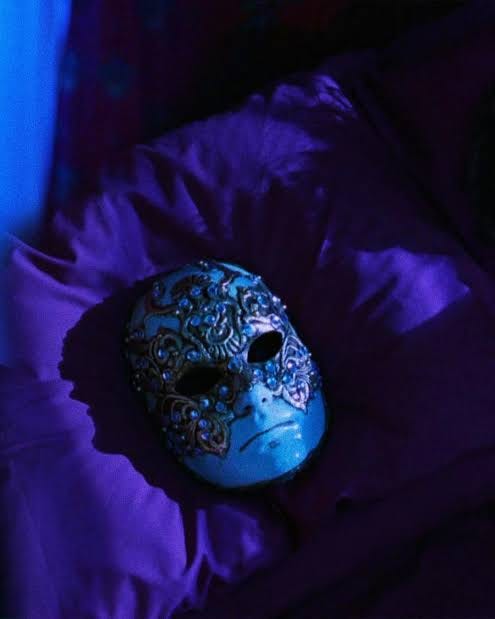
We can think of the visages / masks of The Beginnings in a twofold way (differently, maybe, from the father superior’s two heads): first, as the mediating surface, or mirror, through which the world becomes descriptively reflected to a higher power;19 second, as a passport to Rabelaisian anonymity, as is proper to the chaos of Carnival.
The two sides of the plane of the visage gleam with reflective beauty and a joyful linguistic debauchery.
Evening would descend, the street sparkling for an instant, then vanishing. I’d crane my neck a bit within the frame, seeing in the rearview mirror that the white-faced worker was bringing the already lit cigarette up to the blinding stain of his visage, but, each time, I couldn’t comprehend what he was sucking at it with. [Emphasis mine.] […] The stain of his visage would become even more dazzling alongside the drop of light that was the bulb. He’d stop to gaze upon it from right up close before unscrewing it, the cloud of mosquitoes seeming unable to bite his visage.20
Moresco’s whirl of imagery surges magmatically (he often uses the word “magmatic,” especially to describe light) out of the opening created by his suspension of proper names and the bored metaphysical truce between the horror and hilarity of the real—mediated and multiplied forth by the visage.
The streets were deserted, the sidewalks all scratched up by the cuts of shovels. The sky was white, reflective. You couldn’t see those low-hanging stars, those stars. “They must all already be asleep . . . all extinguished . . . there’s only the little magmatic light that palpates all night beneath that sacred image, like an egg yolk . . .” I thought, breathing onto my frozen, stylized fingers.21
This imagery is visceral—in the non-hyperbolic sense of actual viscera. There is something organic and semi-repulsive about everything inorganic in the world of The Beginnings. Light palpates, becomes an egg yolk; elsewhere, clothes take on the role of skin, “crepitating” —or, for example:
Smudges of slightly exfoliated light would ride the curvature of each pebble, all of them together forming something like a pale galaxy.22
This is absolutely beautiful. But there is also something about it that makes my skin crawl.
Exfoliated light. Exfoliation is one of those words whose connotation blinds us to its other possible definitions. Exfoliation can be used in a geologic, inorganic sense. Thus, it means: “a process resulting in parallel fractures in the surface of rock”, which fits well in this context.23 But when you read the word “exfoliated,” that’s not what you think of, is it? You think of “the removal of dead skin cells and built-up dirt from the skin’s surface”,24 which is itself a second-order organisicm derived from the latin exfoliare, “to strip off leaves.” (Again, sgranato/shucked suggests itself. —Lawton gives the original as sfaldarsi, which can mean exfoliate or disintegrate: I suspect he chose the former word rightly, as “disintegrate” is far less ambiguous than “exfoliate.”)
This level of highly ambiguous imagery affects how we read the otherwise innocuously pleasing phrase, “pale galaxy”—the paleness of this galaxy now has something about it of dead skin cells being impersonally scraped away, under the mask / visage, both somehow living and dead, of us and our narrator.
“At the end of the end of the day […]”
As you finish The Beginnings (and so get closer and closer to Songs of Chaos, out in 2027), it becomes apparent that whatever distinction you thought might have existed between action and description, between depth and surface, is likely a groundless fantasy on your part and that it’s really all just one screaming plane of crystalline language—which dons your fantasy like a mask, a volto—the plane of one great, shining visage fleeing and reflecting in every direction.
I look forward to seeing how Songs of Chaos thwarts what I have said above, as I suspect it will with a violence.
Antonio Moresco, The Beginnings, trans. Max Lawton (Deep Vellum, 2026), 541.
Thomas Man, Doctor Faustus, trans. James Wood (Vintage International, 1999), 22.
Notable exception: a caretaker called “Lenìn” in Part 1—not to be confused with Vladimir Ilyich Ulyanov, i.e., Lenin, who comes up in Part 2, along with Dzhugashvili (Stalin), Krupskaya, Dzerzhinsky, all present in a story told by the Fop, along with some other proper names, none of which are spoken by the narrator himself; some proper names also appear, quite oddly, in “The Party” chapter in Part 3—but I won’t spoil any of that.
Francesco Pacifico’s introduction, Moresco, 16.
Quoted in Ludwig Wittgenstein, Philosophical Investigations, trans. G. E. M. Anscombe (Blackwell Books, 1972), 2e.
Moresco, 30–31.
Ibid., 172.
Walter Kaufmann in Johann Wolfgang von Goethe’s Faust, Introduction, trans. Walter Kaufmann (Doubleday, 1961), 13.
Part 1 seems to be “internally determined” by the narrator’s silence, Part 2 by his speech and Part 3 by his writing or having-written.
Ibid., 13–14.
In the way of a simplistic notion of “action” divorced from “style,” which, as I am trying to indicate, you can’t really do with this novel.
Moresco, 492.
Moresco, 23.
Gilles Deleuze and Felix Guattari, Kafka: Toward a Minor Literature, trans. Dana Polan (University of Minnesota Press, 1975), 4.
Ibid., 5.
Thus “hysterical,” above.
I am very grateful to Max for the review copy and for his helpful answers to my questions about Moresco’s Italian, specifically the two words I’m focusing on here.
Ibid., 473.
I owe this image of “exponential reflection” to Walter Benjamin’s “On the Concept of Criticism in German Romanticism”, and so also to the work of Novalis and Schlegel.
Moresco, 340, 341.
Ibid., 485.
Ibid., 324.
https://en.wikipedia.org/wiki/Exfoliation_(geology)
https://en.wikipedia.org/wiki/Exfoliation_(cosmetology)
Beautiful review. Thank you.