

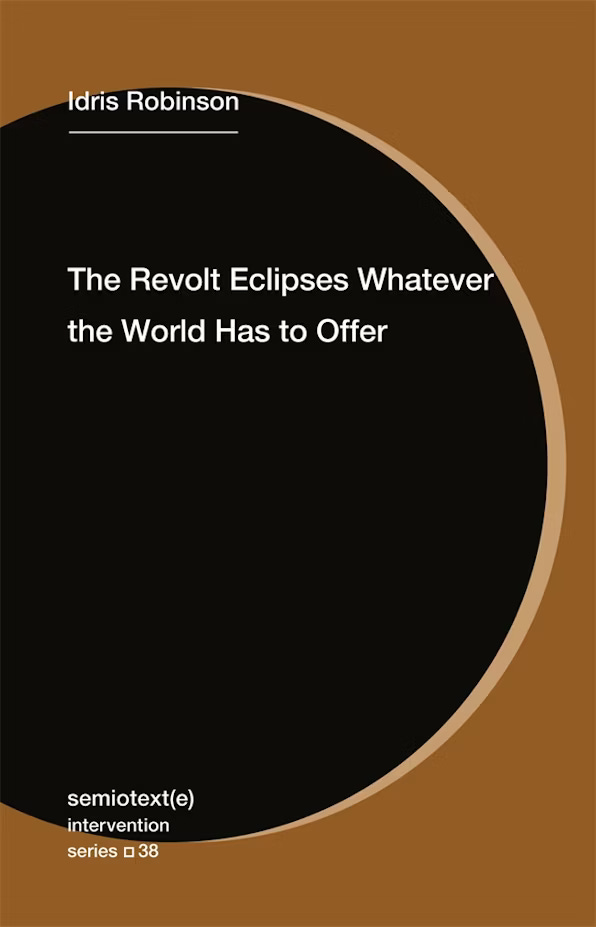
REVIEW: The Revolt Eclipses Whatever the World Has to Offer, by Idris Robinson
THE SONG OF HEAVEN... CURSE NOT THIS LIFE

Heir to a dreadful past
As I draft beginning after beginning of my review of Idris Robinson’s The Revolt Eclipses Whatever the World Has to Offer, available now, from Semiotext(e), as #38 in the infamous Interventions Series, I find myself doing a lowly thing that no reviewer or writer should ever do: I am half-consciously preempting some other imagined reader’s opinions about Revolt and partially responding to those, even as I address the real reader of the book—from out of the opening that Revolt vies to enlarge.
Now, I want to go into Robinson’s singular work of politics, agitation, autobiography, philosophy and eulogy—but it might be useful to seize this unclear, imagined reader and not dismiss him right away. We should take the opportunity to bring him into the foreground, expose him, give him a dressing down, and, at last, get him out of our sight, because not only is he an illustrative example, albeit negatively, but he’s obstructing our view. This imagined reader does actually have a name, but I’ll keep that in my back pocket for a minute.
What does this reader look like? He has a puckered face; it is an expression that has much pretense to being sensible (forgive the construction, but “sensibility” has different connotations). Actually, he’s a smug guy who thinks of himself as a “realist” in the uncritical sense. Maybe he’s right-wing. Maybe he’s “left-wing”. Maybe he sees himself as some kind of “libertarian” —or a centrist (in which case, watch out, because these, not the “political extremists,” are the guys who go out and blow people away in the street—go ahead, read the manifestos… their grievances often boil down to “society” not being quite sensible enough). But it doesn’t matter, because in any case, all this guy wants is for things to continue on the way they are already going. He believes in technological progress with “all of his being” (just an expression…). In fact, he believes that technology, science, the economy, etc., are all purely apolitical forces, something like forces of Nature, with their own inviolable Laws. He always votes, and it makes him feel better for a while. His most venerated freedom is simply his “freedom of choice”. The idea pretty much stops there.
When this guy, who, let’s be real, will never read Robinson’s book or much of anything at all, hears such a sentence as “The sad fact of the matter is that everyone on our side claims to be waiting for the next John Brown, but when he finally appears before us, we instead line up to unanimously reject him”1, he performs a kind of indignation. He begins to argue without working himself deeply into the proposition. He expresses his faith in debating regardless of the content of his speech: the spectacular sphere of opinions. But what is there to be fruitfully debated about a poetic thesis like the following, which will no doubt put our semi-real spectator (a necessarily redundant phrase) into an arms-crossed pout? “The fulfillment of the revolutionary project is ultimately an inescapable ethical obligation that each of us has to the dead and the exploited.”2
Poetic production3 begets poetic production, and of this our spectator knows nothing.
This is the kind of writing that does not tarry in the limbo of mere opinion. Like the very best prose, Revolt vastly transcends all the lesser concerns of so many of today’s political thinkers tinkerers. Untouched by the purgatory of opportunistic argumentation—which feels quite eternal so long as one participates in it eternally—he operates on the dual rails of thought and action.4
This imagined reader is, in a sense, very real, so easily found out there in the world—and surely in myself, too, for who is fully beyond his reach from within the depths of the integrated spectacle, which, “simultaneously concentrated and diffuse […] has learnt to employ both these qualities on a grander scale”?5 How else does he come so readily, though unbidden, to mind? Well—he has already been named by Tiqqun, the French collective, in their Introduction to Civil War (#4 in Semiotext(e)’s Intervention Series). His name is Bloom.
Here are two explanatory remarks to the appearance of this individual, Bloom, which are not without their ambiguities.
Modeled in part after Leopold Bloom from James Joyce’s Ulysses, “Bloom” is a conceptual persona […] [A] provisional description: “Last man, man on the street, man of the crowds, man of the masses, mass-man, this is how THEY have represented Bloom to us: as the sad product of the time of multitudes, as the catastrophic son of the industrial era and the end of enchantments. But in these designations we also feel a shudder, THEY tremble before the infinite mystery of the ordinary man. Everyone senses that the theater of his qualities hides pure potentiality: a pure power we are supposed to know nothing about”.6
The most Bloomesque notion of freedom is the freedom of choice, understood as a methodical abstraction from every situation. This concept of freedom forms the most effective antidote against every real freedom. The only substantial freedom is to follow right to the end, to the point where it vanishes, the line along which power grows for a certain form-of-life. This raises our capacity to then be affected by other forms-of-life.7
A good book—like many a good poem, piece of music, painting—has this virtual antagonist, this spiritual Smerdyakov, of a spectator, who the book not only generates, however contradictorily, but who also must be destroyed, exiled or transfigured so as to let the book speak clearly.
Robinson’s Revolt sets out to annihilate this subjectivity that can only vaguely (and rather unfreely, we might add) conceive of freedom as “freedom of choice” upon the very ground that no real choice has been or ought to be made. This oscillating conception of freedom borrows its form from Hegel’s “bad infinity”, and its attendant (non-)subjectivity wants nothing more than to go on unaffected by the possibility of the consequences of choice, the beginning of form-of-life. He is allergic to any and all inclination aiming at rupture with the present order.
For those unfamiliar with this term, form-of-life (found, most richly, in Agamben’s Homo Sacer), it is usually counterposed to that of bare life. You can think of form-of-life as a life determined by real political existence, actual as opposed to merely formal freedom (Lenin), as a life that holds its form—its habit, its inclinations, its thought, its art, its action—to be more or less worth defending and even dying for. Bare life, biological subsistence, is the opposite of the sense-pole (but intimately related, like any terms linked by direct polarity). Bare life is the bargaining chip of our contemporary security state that says: “We protect the body at all cost, though the spirit dies.” And it is with this over the gates of our world that the security state—empire, as it may be called—also kills bare life with sovereign impunity, to which form-of-life necessarily bars the way, even in death, the memory of which is once more life.
Idris Robinson is a writer who, with the appearance of his first book, defends the dignity of form-of-life over and above atomized bare life.
We’ve brought the negative figure of a resistant spectator into view, but he is only a well-named negativity generated by the heat of Robinson’s prose: he is a mirage, and he dissipates the closer we get to the text.
I cannot help but think of another spectator, Wilhelm Reich’s “Little Man.” The Little Man is also the bearer of a “pure potentiality we are supposed to know nothing about.” Reich addresses the Little Man: “You are heir to a dreadful past. Your heritage is a burning diamond in your hand.”8 I can imagine these words heading any of the invectives of Revolt.
I hope that you, the reader in potentia, will be able to see much more powerfully the superimposed figures positively present in Robinson’s book when you open up its pages: the insurgent and the writer himself who remains valent, or else poised, like some sensitive substance hovering between different states of matter into which he might phase-shift at the slightest change in temperature or barometric pressure. At one moment, he elegantly frames his beautiful translations of Plato. At the next, he pries a brick up from the pavement in the megalopolitan whirl.
Idris Robinson is intensely aware of our situation in America and the Americanized world at large. So many of us feel that things cannot merely go on like this forever: the endless qualification and encroachment of the powers of a massive police–surveillance state, the constant, ouroboric funding-of and profiting-from the death machine in every possible country, capital accumulation at speeds and magnitudes not seen in any other epoch of world history, the embalming of social life with the formaldehyde of images that undergird such spectacular accumulation… The Hydra-headed bloat of it all is unnerving. Guy Debord, in Comments on the Society of the Spectacle, puts it more soberly:
The society whose modernisation has reached the stage of the integrated spectacle is characterised by the combined effect of five principal features: incessant technological renewal; integration of state and economy; generalised secrecy; unanswerable lies; an eternal present.9
It is with an awareness of this state of affairs that Robinson moves like a real poet—whether a François Villon or a Cannibal Ox—between registers and between, no doubt, the upright forms of the living, just as much as those of the dead to whom his book is addressed.
A burning diamond in your hand
The Revolt Eclipses Whatever the World Has to Offer begins with what might be the most compressed and stylistically diamantine piece of the whole book, which can also be read as a kind of postface: “Writing for the Dead”. It concludes with a provocation of Stockhausen-like proportions. Once the heat has been turned up, we are hit with one of the shortest (but not for that less impactful) pieces in the book, aimed at the perverted subjectivity of the average American liberal:
Isn’t it interesting how progressive whites seem to have a direct line of communication with Black leaders, while everyone else in the street fails to suffer from the same delusional schizophrenia? [...] It is worthwhile to note that Black people, themselves, never refer to any mythical Black leadership. This is because we know, full and well, that all of our leaders, since Martin and Malcom, have been killed.10
The following texts are transcriptions of talks given during the 2020 George Floyd uprising, theses on the same, followed by timely—dialectical—explications and clarifications of those theses; explosive, clear-eyed analyses are followed by three pieces of what you could call, at different moments, eulogy, panegyric, autobiography—indeed, remembrance (recherche or “search”), in the Proustian sense, the object of which is the resurrection and finally-attained victory of the dead, of that which has been lost to the indignities of time and history.
Revolt confronts us with the growing reality of a budding state of civil war, or stasis. Rather than what we often think of as a discrete revolution, which seems a long way off in a federated republic such as ours, Robinson urges us to also think in terms of stasis, a distinct kind of civil struggle (brought into relief in Agamben’s Stasis: Civil War as a Political Paradigm) immanent to American life. What is the core of such a mode of struggle? It is the remembrance and vindication of the memory of all previous revolutions, of previous civil war, of previous insurrection. Revolution, however, is never entirely off the table.
I am not advocating another series of Yugoslav Wars, nor am I advocating what has occurred in Syria. Nonetheless, we must harness civil war [stasis] as an emancipatory, liberatory power.11
[T]he fight is not only for the living, but also for the dead. We owe the revolution to the millions of slaves who never knew a second of freedom. What the long list of martyrs who have fallen during this uprising deserve from us is nothing other than the completion of the revolution.12
These pieces weave together and fray out into bursting attacks: attacks on both facets of the police state—the police themselves and their liberal counterparts who want nothing more than to keep protests as docile and unthreatening as possible, who peacefully hold hands as they segregate the masses from within: “You’ve all been in these marches,” says Robinson, “these ridiculous marches, where it’s ‘white people to the front, Black people to the center’—this is just another way of reimposing these [racial] lines in a more sophisticated way.”13 Revolt throttles the fantasy that such sorry performances are in any sense revolutionary.
The historical example of the real “freedom fighter” in Revolt is not Abraham Lincoln. It is John Brown. There is a tragic dimension to Revolt not to be found in the hagiography of statesmen.
There are surprising lines lying in wait for us at every turn of Revolt. Here is just one that took me personally off-guard: “In order to fend off its own dissolution, white supremacist society tells us that there is nothing more insane than the desire to be born with Black skin. This is how they present Rachel Dolezal to us.”14 This is from “Letter to Michael Reinoehl”, one of the most affectively powerful moments of Revolt.
We then have the interview (conducted by Gerardo Muñoz) from which the volume takes its title, followed by an epigrammatic blast that clears the way for the most intense theoretical engagements of the book. The last two pieces are once again composed in an autobiographical vein. In equal measure, they are about colonizer and colonized, murderer and murdered.
Now—although this is a book about the horrifying Real of racial violence, the libidinal core of America, civil war, insurrectionary fury, the memory of the dead, refined forms of state repression and Walter Benjamin’s conception of divine violence—it would be a big mistake not to acknowledge the author’s sense of humor.
Based on a close reading of the fifth chapter, “The Poor Man’s Luigi”, it may even one day be said that Occupy Wall Street did indeed cause far more chaos and destruction than anyone could have imagined: It annoyed Idris Robinson so much that, rather than participate in its star-spangled non-being, he decided to go—to graduate school. But he says it best himself:
Basically, my decision came down to this: whether it was the movement or academia, either way I’d be surrounded by a bunch of trust fund kids lying about their allowances; but at least with grad school, I’d leave with a diploma to show for all of it.15
Some of this piece is spent recounting a less-than-glorious confrontation with the NYPD in which Robinson “decide[s] to practice some roundhouse kicks” and ends up hurting nobody but himself while “[l]ooking like Crouching Tiger, Hidden Asshole”. This lands him “shackled the fuck up in the back of a prison van”.16 And you’ll never believe who he ends up in jail with... I want to tell you outright, but I’m afraid it would give the game away too much. Instead, I’ll tell you something else, and I’m only going to say it once: get the book yourself and read it. Its dynamism, its storytelling and its theoretical backbone make up a rare troika.
Structurally, Revolt reminds me somewhat of the recent (Verso, 2024) edition of writings by and about V. I. Lenin, edited by Tamara Deutscher, Not By Politics Alone: The Other Lenin—but only if this fine volume had been interspersed by the most flaming, critically ruthless—i.e., political—chapters of The State and Revolution and What Is to Be Done?
Robinson engages with the same fundamental questions of revolutionary thought and action, within the context of America, understood as an involuted, biopolitical manager-state. The core question to be grappled with here is that of katārgesis. Robinson analyses and separates this Greek term, which corresponds with “destituent power”, into the dual senses of deactivation and destruction. The former sense (and translation) of katārgesis (deactivation) is found mainly in the work of Agamben. The latter (sense/translation), destruction, is found—and this is my comparison—in Lenin. Open up your copy of The State and Revolution. Lenin emphasizes again and again, as a prerequisite to the withering away of an implicitly secondary state—i.e., the dictatorship of the proletariat, wherein enters the problem of constituent power—that the primary state, or the current order of things, must be, one way or another, smashed, broken, destroyed (not simply deactivated). Robinson addresses this problem in the latter half of Revolt with impressive analytic dexterity.
I call this a problem. What I am referring to is the antinomy between the two conceptions of power that Robinson explores: constituent power and destituent power (this latter power, split into passive and active forms of destitution). This (theoretical) part of Revolt is so acutely wrought that I lost sleep over it. It is crucial reading for anyone with an intellectual conscience concerned with what they might like to think of as revolutionary politics. (For a doubly fraught night, read Antonio Negri’s introductory essay to The State and Revolution [Verso Books edition, 2024], about constituent and constituted power, alongside Robinson’s analysis of destituent power, as well as his great “Introduction to Mario Tronti’s ‘On Destituent Power’”.)
The Revolt Eclipses Whatever the World Has to Offer is a strong successor to other Semiotext(e) works, like The Coming Insurrection, but it stands in its own right as a singular political, philosophical and autobiographical document. It concludes in the major key with a call to universal solidarity. Alongside Robinson’s words, I also hear those of Rimbaud, whether or not he actually participated in the events of 1871:
When, beyond mountains and rivers, will we embrace the birth of new endeavors, new wisdom, the departure of tyrants and demons, the end of superstition, and be the first to worship Christmas all across the earth!
     The song of heaven, the progress of nations! Slaves, curse not this life.*

⸻⸻⸻⸻⸻⸻⸻⸻⸻
*Arthur Rimbaud, Rimbaud Complete: Poetry and Prose, “Morning”, trans. Wyatt Mason (Modern Library, 2002), 218.Idris Robinson, The Revolt Eclipses Whatever the World Has to Offer (Semiotext(e), 2025), 97.
Ibid., 57, 91.
I take this phrase from Agamben’s works generally—poetic production is not limited to poetry.
The distinction, between the formal sphere of (bourgeois–parliamentary) opinion and the actual of united action and thought, is detailed by Alain Badiou in his essay “Against ‘Political Philosophy’”, in Metapolitics (Verso Books, 2005).
Guy Debord, Comments on the Society of the Spectacle, trans. Malcom Imrie (Verso Books, 1990), 9.
Tiqqun, Introduction to Civil War, endnote 2, trans. Alexander R. Galloway and Jason E. Smith (Semiotext(e), 2010), 227.
Ibid., 25.
Wilhelm Reich, Listen, Little Man! (Pelican Books, 1975), 11.
Debord, Comments, 11–12.
Robinson, 27–28.
Ibid., 57.
Ibid., 58.
Ibid., 39.
Ibid., 105.
Ibid., 114.
Ibid., 116–117.
Nicely done, I suggest also Georges Sorel in the dialogue. A classic. On the use of Violence. I don't need to go deeper you already know
The Debord line got me experiencing heart palpitations